
Platinum Silicone vs Latex vs TPE — Why Mask Material Matters
The single biggest factor in how a realistic mask looks, feels and lasts is the material it is cast from. The differences are not subtle, and the photograph below explains most of the story before a single paragraph of text — the same hand-sculpted portrait, cast in four different materials, displayed under identical lighting.
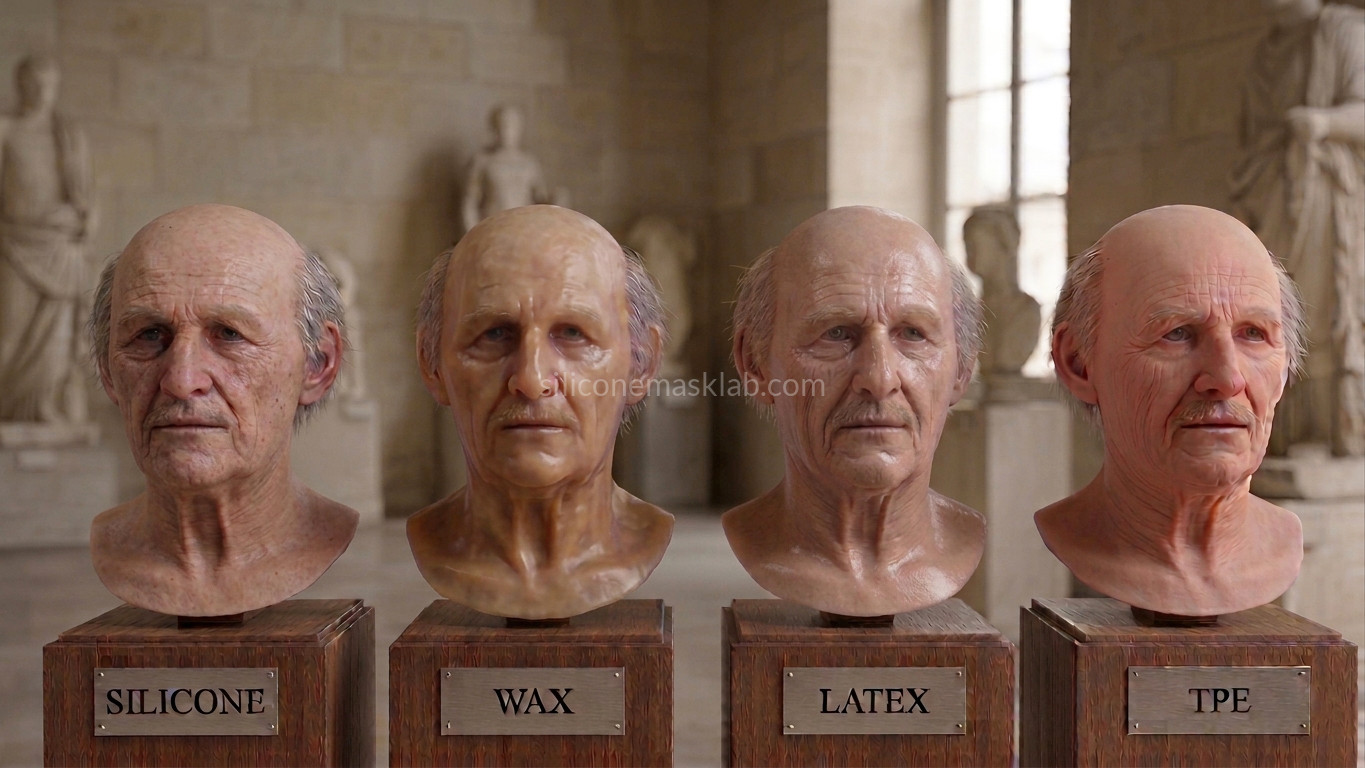
Same sculpt, four materials. SILICONE — WAX — LATEX — TPE. The differences are not subtle.
All four busts above came from a single master sculpt — built by hand in our studio over multiple sessions, working from a live reference. The anatomy, the pore topology, the proportions: identical. Everything you see different between the four casts is caused by the material, and only by the material.

Our studio: the master sculpt used for the four-material test was built here from a live reference.
That sculpt took roughly 40–80 hours to build, in oil-based clay on a calibrated armature, the way classical portrait sculpture has been made for two millennia. The Roman busts you see on the upper shelves in the studio are not decoration — Greek and Roman portraiture is still the most rigorous study of human anatomy ever produced, and it remains the foundation our sculptors work from.

Hand-sculpting in oil-based clay — 40 to 80 hours from blocked-in armature to final pore-level detail.
Once the master sculpt was finished, a mould was taken and the same form was cast in four different materials. What you are seeing in the comparison photograph above is therefore an isolated experiment: every variable held constant except the material. The rest of this guide explains what each material actually does — and how to tell the four apart when you are looking at a listing online and not at four casts on identical pedestals.
At a Glance
| Latex | Wax | TPE | Tin-Cure Silicone | Platinum-Cure Silicone | |
|---|---|---|---|---|---|
| Wearable? | Yes (poorly) | No — museum only | Yes | Yes | Yes |
| Typical price | $30–$200 | n/a (commission) | $80–$400 | $300–$700 | $500–$3,000+ |
| Skin-safe (ISO 10993) | Often allergenic | n/a | Variable | Generally yes | Yes |
| Mimicry / expression | None | None — solid | Limited | Good | Excellent |
| Accepts makeup repeatedly | No (stains, cracks) | n/a | No — stains permanently | Yes | Yes |
| Lifespan | Months | Decades (static) | 6–18 months | 5–10 years | 45+ years |
| Smell | Strong rubber | Mild waxy | Mild plastic | None / faint | None |
| Heat behaviour | Traps heat | Melts at body temp | Traps heat | Breathable | Breathable |
Latex
Latex was the standard mask material for Halloween, theme-park costumes and low-budget film for decades. It is cheap and easy to mass-produce. It is also where most of the negative stereotypes about “rubber masks” come from.
In the comparison photo, the LATEX cast is third from the left. Look at the cheek. The colour sits on top of an opaque, matte surface — there is no warmth coming through from underneath. Compare directly to the silicone cast at the far left: same anatomy, but the latex face reads as a painted object while the silicone face reads as a person. That difference is what no amount of hand-painting can fix in latex.
Pros: low cost, lots of designs, easy to find.
Cons:
- Strong rubber smell that does not fade.
- Traps heat and sweat — uncomfortable after 30 minutes.
- Does not move with your face — expressions do not transfer.
- Cracks at flex points after a handful of uses.
- Requires talcum powder on your face just to slide on.
- Latex allergies are common.
- Pigments grind into the porous surface; makeup attempts ruin the finish.
When latex is fine: single-use Halloween costume, a quick gag, a one-shot photograph. Not a tool for serious work.
Wax — Why It Doesn’t Belong on a Face
Wax has one of the longest histories in hyperrealistic portraiture. Madame Tussauds has been making wax figures since the 18th century, and the surface quality under controlled museum lighting can be extraordinary.
In the comparison photo, the WAX cast is second from the left. Look at the forehead and the cheek — wax has its own subsurface translucency, and you can see it: a soft honey-amber glow, light entering the surface and exiting warm. The skin tone, however, is the giveaway. Wax produces its own warmth, but it is amber-honey, not the cooler underlying tones of real skin. As a static museum piece this is stunning. As a wearable mask it is impossible, for four practical reasons:
- It cannot flex. Any attempt to put it on a face and smile cracks it on the first try.
- It melts at body temperature. Roughly 38–50°C depending on formulation — that is body temperature on a summer day.
- It records every contact permanently. Fingerprints, dust, scratches all imprint and stay.
- Painted layers chip. Surface paint, not infused colour. Wax cannot accept embedded pigments the way silicone can.
This is why wax figures live in climate-controlled museum halls behind ropes, and why no wearable-mask studio in the world casts in wax. Beautiful, but the wrong tool.
TPE (Thermoplastic Elastomer)
TPE is the middle-of-the-Amazon-listing material. It looks like silicone in photos. It feels almost like silicone in your hand. It is significantly cheaper than real silicone. And it has one fatal flaw for anyone planning serious use: it stains permanently from the first makeup application.
In the comparison photo, the TPE cast is on the right. Look at the colour: it is the most saturated of the four, distinctly pink — almost doll-like. The surface has a faint plastic gloss. Light bounces off rather than penetrating. Compare to the silicone cast at the other end of the line: the silicone reads as “person”; the TPE reads as “high-end collectible figure”. In product photography, TPE often passes a quick visual check. In a side-by-side test like this one, the disguise dissolves immediately.
Pros: softer than latex, cheaper than silicone, decent visual quality on day one.
Cons:
- Pigments from foundation, lipstick and SFX paints bind to the surface and will not wash off. After one bridal look, the mask is permanently tinted.
- Absorbs skin oils — develops a sticky, discoloured patina in 6–12 months.
- Degrades from sunlight, heat and air exposure. Eventually goes brittle.
- Mimicry is mediocre — TPE does not transmit micro-expressions cleanly.
When TPE is fine: a static display piece, or a one-look photoshoot where you are not planning to redo the makeup. If you ever want to apply cosmetics on the mask, choose silicone instead from the start.
Tin-Cure Silicone
The cheaper of the two silicone grades. Used for film props, low-cost prosthetics and budget character masks. Performs much better than latex or TPE, but has limitations.
Tin-cure is not represented in the four-material photo — it would sit visually between platinum silicone and TPE: better than TPE on translucency, less stable than platinum over years.
Pros: reasonable price, good initial look, accepts makeup, decent mimicry.
Cons:
- Cures with byproducts that can react with skin in some people — biocompatibility is variable.
- Lifespan ~5–10 years; the surface gradually breaks down and becomes tacky.
- Less stable colour retention than platinum cure.
When tin-cure is fine: short-run productions where the mask only needs to last a year or two; props that will not touch skin for long periods.
Platinum-Cure (Medical-Grade) Silicone
This is the material we use for every realistic mask at S.M.LAB and the material every serious specialist (CFX, Immortal, RealFlesh, Metamorphose) builds on. It is the same chemistry used for medical implants, baby pacifiers and food-safe utensils. The full technical breakdown lives on our Materials & Technology page.
In the comparison photo, the SILICONE cast is on the far left. Look at what makes it look alive. The forehead has visible Sub-Surface Scattering Engineering™ — light entering the surface and exiting warm, exactly the way it does in living skin. There is colour variation: subtle pinks in the cheek, slightly cooler at the temples, warmth pooling around the lips and nostrils. Pore detail reads at this distance. The silver hair integrates into the silicone scalp with no visible edge because it is hand-punched, strand by strand. The eyes sit correctly because the surrounding silicone is thin enough to behave like real skin. This is the bust most people would walk past in the photo without registering that it is not alive.
Pros:
- ISO 10993 certified — biocompatible, hypoallergenic, safe for prolonged skin contact.
- No degradation from oils, sweat, sunlight or cosmetics. Lasts decades.
- Sub-Surface Scattering Engineering™ produces genuine “skin glow” rather than a flat painted look.
- Excellent mimicry transfer — micro-expressions read through to the silicone surface.
- Accepts and releases cosmetics without staining — a true makeup canvas.
- Thermal stability from approximately –60°C to +200°C.
- Hydrophobic and antimicrobial.
Cons:
- Cost — platinum-cure raw material is several times the price of TPE or tin-cure.
- Heavier than thin latex (an honest realistic mask weighs about 350–500 g depending on the model).
When platinum is right: any serious project. Film, theatre, regular cosplay, makeup-artist training, personal feminine or masculine expression, photography — anything where you will wear the mask more than a handful of times. The economics work: a single $500 platinum mask outlasts ten $100 TPE masks.
How to Tell Materials Apart on a Listing
Sellers often blur the line. Some practical checks:
- Price. Realistic platinum-silicone masks at $80 do not exist. If the price seems too good, the material is latex or TPE.
- Smell. Latex smells strongly of rubber; TPE has a mild plastic smell; tin-cure silicone may have a faint vinegar note; platinum silicone has no smell.
- Stretch test. Latex tears easily and feels dry. TPE stretches but does not fully spring back. Silicone stretches a lot and returns to shape immediately.
- Visual: look at product photography in dark studio light. Latex looks flat-matte. TPE looks plastic-glossy. Silicone shows the warm undertone of the cast on the left of our comparison photo.
- Ask for certification. A reputable seller can provide ISO 10993 documentation for platinum-cure material.
Frequently Asked Questions
Is “medical-grade silicone” the same as platinum-cure?
Practically yes. The medical-grade designation is what is used in implants and indicates ISO 10993 compliance. All medical-grade silicone is platinum-cure.
Why do platinum-silicone masks cost so much more?
The raw material is several times the cost of TPE, the cure cycle is longer, hand-painting and hair punching are labour-intensive, and the moulds and tooling are expensive. The price reflects what is inside — the four-material comparison at the top of this article shows exactly what you are paying for.
If wax can look so realistic, why don’t you make wax masks?
Wax is a static-display material. It melts at body temperature, cannot flex with facial movement, picks up fingerprints permanently, and chips when handled. It is wonderful for museum portraiture and impossible for anything you wear on your face.
Can I tell from a YouTube review which material a mask is?
Sometimes. Watch how the mask moves when the wearer talks — platinum silicone transfers expression, latex and TPE do not. Watch close-ups under good light for sub-surface scattering glow rather than a flat painted look.
What about resin or PVC masks?
Both are rigid and not suitable as wearable realistic masks. PVC is sometimes marketed as “soft silicone” but is generally TPE-class material.
Once you have chosen the right material, the next questions are about wearing and customising.
Leave your comment
Related posts
Wig, Hand-Punched Hair, or Ready-Made Hairstyle? Choosing Hair for Your [...]
Yes, You Can Apply Real Makeup on a Silicone Mask [...]
How to Put On and Wear a Realistic Silicone Mask [...]